Ready for the Feel Gut Weeks?

Up to 12 bottles FREE: DISCOVER NOW

--

Days

--

Hours

--

Mins

--

Secs
Login

– Before you continue reading –

Not only do we know almost everything about kombucha, we also brew it!

Our 8-times award-winning Raw Kombucha combines millions of active cultures with smart organic ingredients and vitamin C. Thirsty yet? Visit our shop and see for yourself!

Try Kombuchery
Editorial Note: This article deals with general scientific findings on kombucha and not with Kombuchery products. Scientific findings and study results are not automatically transferable to individual foods or products. The article does not replace medical or nutritional advice and is not to be understood as a health-related statement about specific foods or products.

The content is based on scientific literature, publicly available sources, and the author's assessment, and does not claim to be exhaustive. New studies may confirm, supplement, restrict, or refute existing findings. Scientific publications should therefore always be considered in the overall context of the available evidence.

Studies generally refer to the specific conditions, ingredients, microorganisms, dosages, manufacturing processes, and groups of people investigated. The presented results cannot therefore be readily transferred to other foods, recipes, manufacturing processes, or products.

No statements about the effects, properties, or health benefits of specific foods or products can be derived from the information presented.

Health-related claims for foods in the European Union are subject to the applicable legal requirements. The presentation of scientific research is therefore not to be equated with a permissible health-related claim about a food or product.

If you would like to delve deeper into a topic, we recommend consulting the scientific sources linked in the article and other independent specialist literature to gain as comprehensive an understanding as possible of the current state of research.

Grow Your Own Kombucha SCOBY with Simple Equipment

We’ll explain how you can easily grow your own kombucha SCOBY, also known as a tea fungus, with a little patience and the right ingredients. The most important ingredient is unpasteurized, raw kombucha, which introduces live microorganisms and sufficient acidity to the starter. Combined with sweetened tea, this allows the yeasts and bacteria to develop into a distinctive culture and form the typical jelly-like layer on the surface.

For your SCOBY to grow well, it needs suitable conditions: a clean location away from direct sunlight and a consistently stable room temperature of around 20 to 25 °C. Other environmental conditions can also affect fermentation. For getting started at home, we’ll focus on the most important factors. And you’re off: grow your own SCOBY!

You’ll need:

  • 1 large, thoroughly cleaned glass container with a wide opening
  • Tea – for example, green or black tea without flavorings or artificial additives
  • Organic organic cane sugar
  • Water, filtered if necessary
  • Unpasteurized kombucha as a starter liquid, for example Kombucha Original
  • 1 clean, breathable cover cloth and a rubber band to secure it
  • A location with a consistently stable temperature of around 20 to 25 °C, away from direct sunlight

Ready to SCOBY: How to grow your own kombucha SCOBY

  1. Brew the tea with hot water and let it steep for 8 to 10 minutes. Use around 8 g of tea and 60 g of organic cane sugar per liter of water. Stir in the sugar until it has completely dissolved.
  2. Let the sweetened tea cool completely to room temperature. Hot tea can harm the live microorganisms in the kombucha starter.
  3. Pour the cooled tea into a thoroughly cleaned glass container.
  4. Add the unpasteurized kombucha at a ratio of 1:10, for example 100 ml of kombucha starter per 1 liter of sweetened tea. Use a sufficiently acidic starter if possible, so that the starter has a suitable acidic environment from the very beginning.
  5. Cover the container with a clean, breathable cloth and secure it with a rubber band. This allows air to reach the starter while keeping insects and other contaminants out as much as possible.
  6. Place the glass in a safe place with a stable room temperature and let the starter ferment undisturbed.

Now comes the waiting, waiting, waiting!

Depending on the temperature, starter liquid, and other conditions, it can take around 7 to 21 days for a clearly visible new SCOBY layer to form. At first, small bubbles or a thin, translucent film may appear on the surface. Over time, this can develop into an increasingly thick, cream-colored to light beige layer.

Important: Not every change on the surface is automatically normal. Fuzzy, dry patches or distinctly green, blue, black, or otherwise conspicuously discolored areas may indicate mold. If in doubt, discard the entire starter, including the culture, and do not taste it. Cleanliness and a sufficiently acidic starter are essential for safe fermentation.

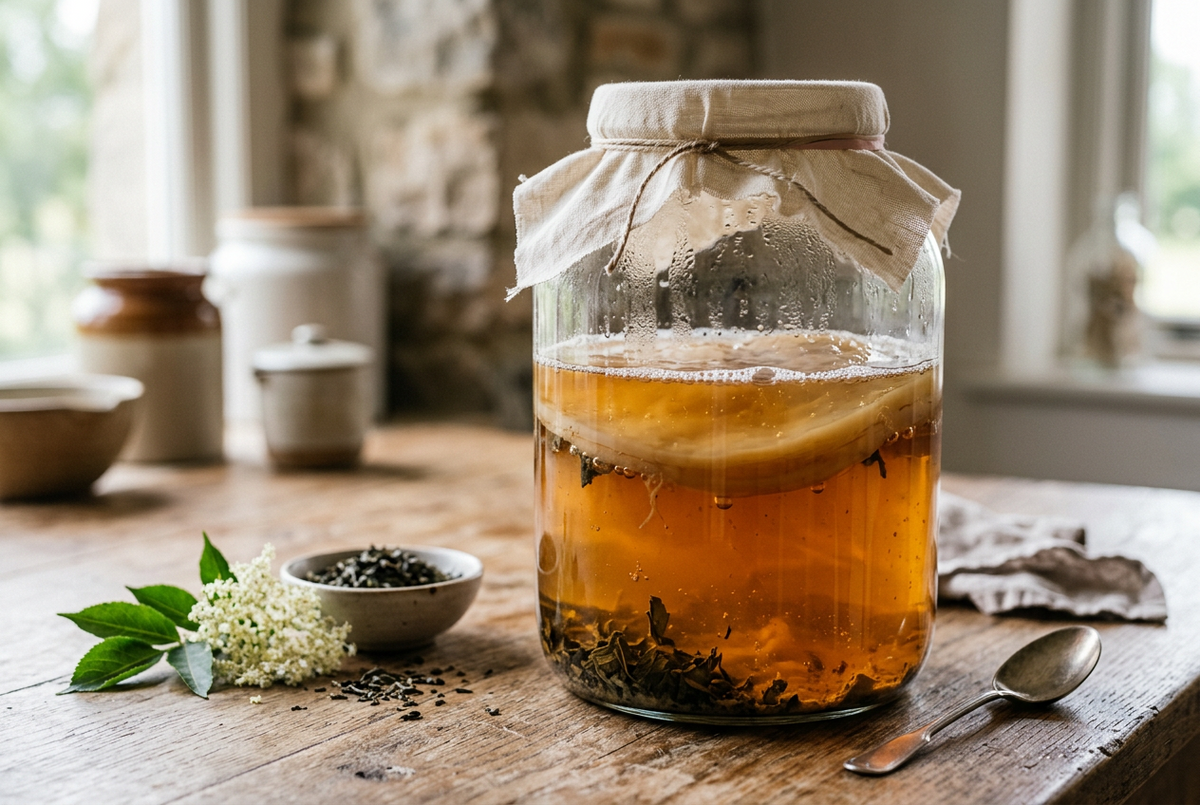
Fermenting kombucha at home and growing your own SCOBY Development of the kombucha SCOBY during fermentation SCOBY formation on the surface of a kombucha starter
Progressive development of the kombucha culture in the glass Homegrown kombucha SCOBY after fermentation

Frequently Asked Questions About Growing a Kombucha SCOBY

How long does it take to grow a kombucha SCOBY?

Under suitable conditions, a new SCOBY layer can form within around 7 to 21 days. The actual duration depends on factors such as temperature, starter liquid, and the condition of the starter.

Can I grow a SCOBY without unpasteurized kombucha?

For this method, you need a suitable starter liquid containing live microorganisms. Pasteurized kombucha is generally not suitable for this purpose. Also, make sure the starter is sufficiently acidic.

How can I tell if there is mold on my kombucha starter?

Mold can appear as a dry, fuzzy coating, often with conspicuous green, blue, black, or otherwise discolored patches. In contrast, a normal SCOBY layer is usually moist and smooth or slightly uneven. If you suspect mold, discard the entire starter, including the culture, and start over with a clean container and fresh ingredients.
3 comments

    • Barbara
    • August 27, 2026 at 5:06 pm

    Hallo, kurze Frage: wie verpackt ihr den Teepilz und Ansatzflüssigkeit für den Transport per Post? Ist der Versand im Sommer ( jetzt: Temp. über 30 Grad!) ein Problem?
    Danke für eure Antwort!
    Herzlicher Gruß
    Barbara

    • Isa
    • June 18, 2025 at 2:09 pm

    Liebes Kombuchery Team,
    ist das Verhältnis 10 Teile Tee und 1 Teil unpasteurisierten Kombucha oder andersrum?
    Herzlichen Danke!

    • Karin
    • October 15, 2024 at 10:33 am

    Danke für die Anleitung. Ich habe meinen ersten Scoby mit einer kleinen Menge sehr starkem, süßen Tee angesetzt und, nachdem der Scoby sich dünn gebildet hatt, nochmal vorsichtig neuen Tee dazugegeben. Hat auch geklappt 😃

Leave a comment

Please note, comments need to be approved before they are published.

This site is protected by hCaptcha and the hCaptcha Privacy Policy and Terms of Service apply.

Recommended articles for you

More of my articles, from A, like alcohol-free kombucha cocktails, to Z, like lemon-ginger kombucha, can be found on our Kombuchery blog. Let's learn more about kombucha together!

View all

Fermentierte Lebensmittel im Winter: Welche Zutaten haben Saison?

Fermentierte Lebensmittel im Winter: Welche Zutaten haben Saison?

Wenn es draußen kälter wird, verändert sich auch die Auswahl an frischen Zutaten in der Küche. Statt sommerlicher Tomaten und Zucchini stehen jetzt Kohl, Karotten, Rote Bete und Wurzelgemüse im Mittelpunkt. Viele dieser Zutaten lassen sich wunderbar fermentieren und bringen...

Read moreabout Fermentierte Lebensmittel im Winter: Welche Zutaten haben Saison?

Warum enthält Kombucha Zucker, obwohl er fermentiert wird?

Why does kombucha contain sugar even though it is fermented?

You may have already wondered: Why does kombucha contain sugar even though it is fermented? After all, some of the sugar is converted by yeasts and bacteria during fermentation. But it doesn't have to disappear completely. In this article, you...

Read moreabout Why does kombucha contain sugar even though it is fermented?

Kombucha Ginger im Porträt: Wie schmeckt Ingwer-Kombucha?

Kombucha Ginger in Focus: What Does Ginger Kombucha Taste Like?

You like ginger and are wondering what it tastes like in kombucha? Then you will discover an exciting combination here: ginger kombucha combines the characteristic taste of fermented tea with the spicy note of ginger. The result is a drink...

Read moreabout Kombucha Ginger in Focus: What Does Ginger Kombucha Taste Like?

Was ist Raw Kombucha? Der Unterschied zu pasteurisiertem Kombucha

What is raw kombucha? The difference compared to pasteurized kombucha

You've heard of raw kombucha before, but you're not sure what it is? Then you've come to the right place! There is an important difference when it comes to kombucha: some varieties are pasteurized after fermentation, while others remain raw....

Read moreabout What is raw kombucha? The difference compared to pasteurized kombucha

Herbstliche Kombucha-Rezepte: 5 Ideen mit Apfel, Birne und Gewürzen

Autumn Kombucha Recipes: 5 Ideas with Apple, Pear, and Spices

When the days get shorter, the air outside smells of autumn, and we make ourselves cozy at home, a little autumn can also move into the glass. 🍂 How about fruity apple, juicy pear, a pinch of cinnamon, and a...

Read moreabout Autumn Kombucha Recipes: 5 Ideas with Apple, Pear, and Spices

Mate Tee Trinkhalm Mateteegefaess

Mate Kombucha: What you should know about mate tea, caffeine, and yerba mate

Mate tea meets kombucha Mate and kombucha can be combined for an exciting flavor profile: the characteristically bitter, slightly smoky taste of mate meets the typical sweet-tart note of fermented kombucha. Mate tea has a long tradition, especially in South...

Read moreabout Mate Kombucha: What you should know about mate tea, caffeine, and yerba mate

Schwangere Frau im Anschnitt grosser Bauch Wiese Abendsonne

Is kombucha suitable for pregnant women and children? All about the alcohol content

Who should drink kombucha? Kombucha is a fermented tea drink. Fermentation can produce small amounts of alcohol. Depending on the tea used, kombucha may also contain caffeine. But how is alcohol actually produced in kombucha? How high can the alcohol...

Read moreabout Is kombucha suitable for pregnant women and children? All about the alcohol content

Warum kann Kombucha Alkohol enthalten? Alle Fragen zum Alkoholgehalt im Überblick

Why Can Kombucha Contain Alcohol? All Your Questions About Alcohol Content Answered

How is alcohol formed in kombucha? Is there kombucha without alcohol? Can pregnant women drink kombucha? Can I make alcohol-free kombucha? All your questions about kombucha and alcohol answered here!

Read moreabout Why Can Kombucha Contain Alcohol? All Your Questions About Alcohol Content Answered

10 Fakten zu Kombucha kaufen oder selber brauen Inhaltsstoffe

Fermented Tea Drink – 10 Interesting Kombucha Facts

What You Should Also Know About Kombucha 1. Kombucha Shelf Life How long kombucha lasts depends on how it is made, bottled, and stored. Because of this, it is not possible to give a general shelf life of several months...

Read moreabout Fermented Tea Drink – 10 Interesting Kombucha Facts

¹at the time of bottling
²Vitamin C contributes to the normal function of the immune system, normal energy-yielding metabolism, and the protection of cells from oxidative stress.
  • Vitamin C contributes to the normal function of the immune system.
  • Vitamin C contributes to normal psychological function.
  • Vitamin C contributes to normal energy-yielding metabolism.
  • Vitamin C contributes to the reduction of tiredness and fatigue.
  • Vitamin C contributes to the normal functioning of the nervous system.
  • Vitamin C contributes to the protection of cells from oxidative stress.
  • Vitamin C contributes to the regeneration of the reduced form of vitamin E.
  • Vitamin C contributes to normal collagen formation for the normal function of the skin.
  • Vitamin C contributes to normal collagen formation for the normal function of blood vessels.
  • Vitamin C contributes to normal collagen formation for the normal function of bones, cartilage, teeth and gums.
  • Vitamin C increases iron absorption.